
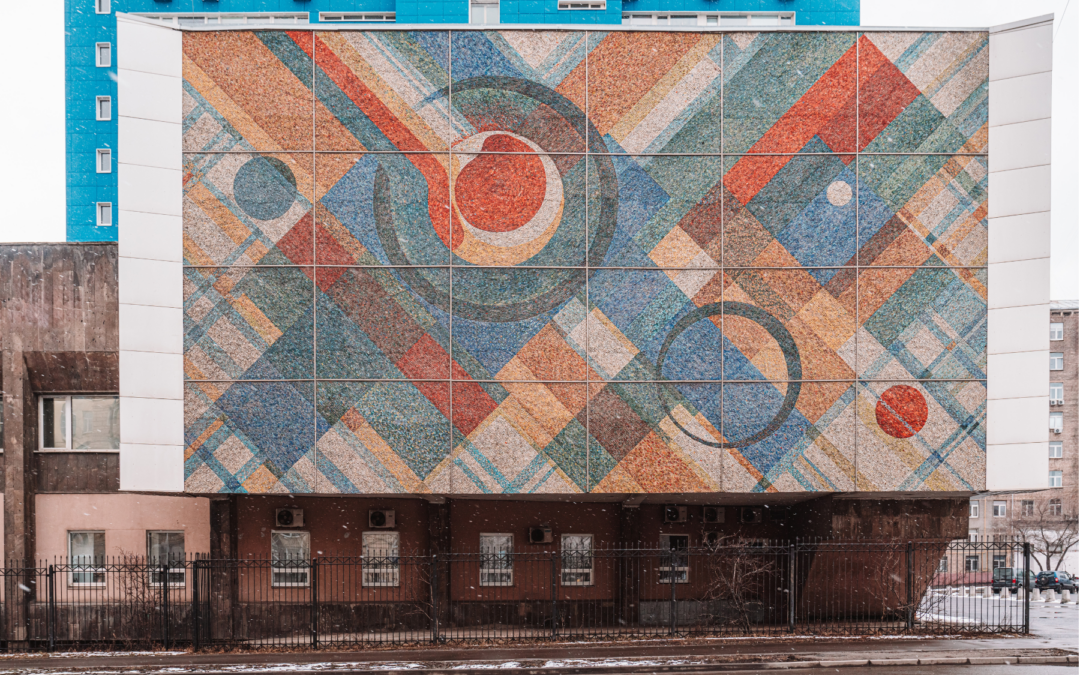
In Slavic mosaic art, meaning does not stop at the central image. The edges matter. Borders play an important role in how mosaics are read, understood, and experienced. Through careful use of framing and edge patterns, artists shaped how viewers approached the artwork as a whole.
Slavic mosaic borders act as visual guides. They separate the mosaic from surrounding architecture while also connecting it to the space. This balance helps mosaics feel intentional rather than decorative. The border tells the viewer where the artwork begins and how to enter it visually.
Mosaic framing often reflects the purpose of the space. In public buildings, borders are usually strong and clear. Thick lines, repeated shapes, and structured edge patterns help mosaics remain readable from a distance. These choices support durability and clarity in busy environments.
In more intimate settings, borders may appear lighter or more fluid. Curved lines and subtle transitions soften the boundary between image and wall. These mosaic framing choices create a welcoming effect and encourage closer viewing.
Edge patterns often repeat shapes found inside the mosaic. This repetition creates unity. When the border echoes internal rhythms, the artwork feels complete. Slavic mosaic borders often use geometric forms because they are stable and easy to repeat across large surfaces.
Geometry also carries symbolic weight. Squares, lines, and interlocking forms suggest order and continuity. These edge patterns reinforce the idea of balance, which is central to many Slavic artistic traditions. Even abstract borders communicate structure.
Color plays a key role in Slavic mosaic borders. Borders often use contrasting tones to separate image from background. Dark edges can anchor a composition, while lighter borders help it blend into the surrounding space. These decisions affect how strongly the mosaic stands out.
Mosaic framing also protects the artwork visually. Borders act as buffers between the image and architectural elements like doors, windows, or signage. This separation helps preserve the integrity of the design even when the space changes over time.
Historically, Slavic mosaic borders evolved with architectural styles. As buildings became more simplified, borders took on greater responsibility. They provided ornament and definition when surrounding surfaces were plain. Edge patterns became a way to add richness without overwhelming the structure.
Artists also used borders to control movement. Repeating edge patterns slow the eye and encourage viewers to take in the full composition. Sharp corners and straight lines create pauses, while curves guide motion. Slavic mosaic borders quietly shape how people look.
In large public mosaics, borders often frame narratives rather than images. Even abstract works benefit from clear framing. It gives the artwork authority and presence within community spaces.
Preservation efforts must pay close attention to borders. Damage or alteration to edge patterns can change how a mosaic is perceived. Restoring the central image without restoring the frame weakens the work as a whole. Mosaic framing is not secondary; it is essential.
Understanding Slavic mosaic borders helps viewers read mosaics more fully. What may seem like decoration is often a deliberate design choice. Borders carry rhythm, balance, and meaning.
For Slavic Art Alliance, highlighting borders supports deeper visual literacy. It encourages audiences to look beyond the center and appreciate the full composition. Edge patterns reveal how thoughtful and intentional mosaic design truly is.
Slavic mosaic borders remind us that every part of an artwork matters. From center to edge, mosaics speak through structure. When framing is understood, the artwork becomes clearer, stronger, and more complete.