Essay · November 19, 2026 · 3 min read
Three Walls of Pattern: Looking Closely at Lany’s Mosaic Bus Stop
By Slavic Art Alliance ·
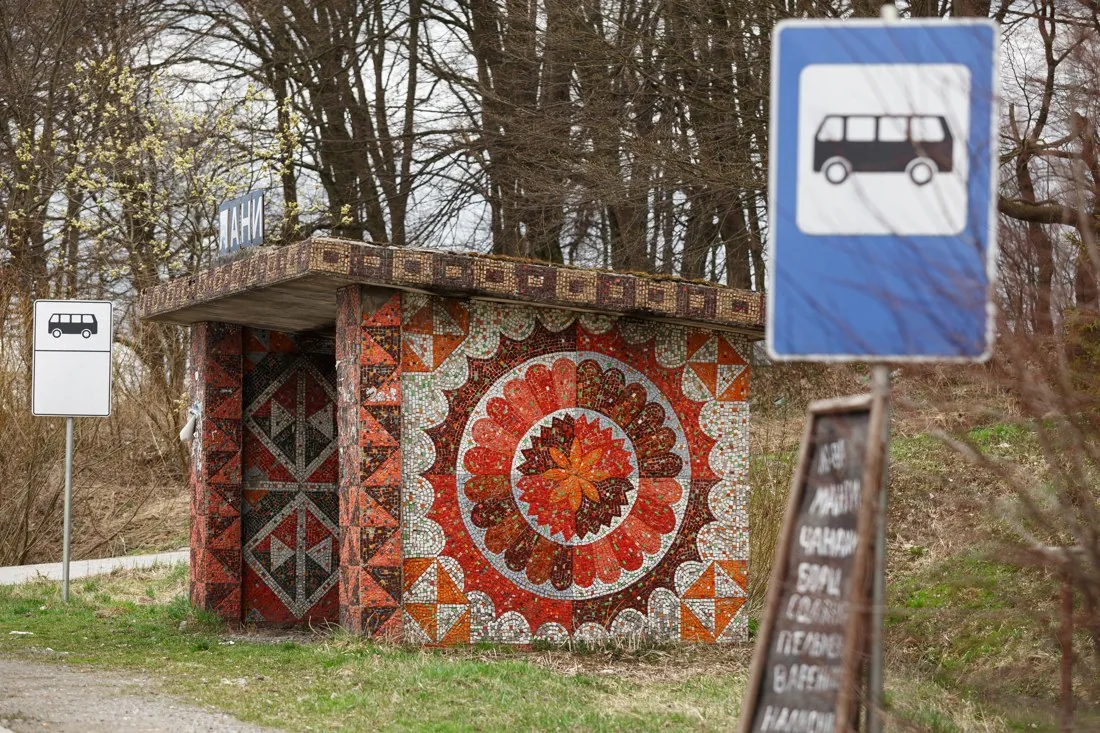
Lany’s mosaic bus stop is small enough to pass in a moment, but its surfaces repay a slower look. The Alliance’s photographic sequence records circular patterns, angular stars and repeated shapes arranged across different walls. The interest lies in their differences, not in assigning every motif a fixed symbolic meaning.
The Lany catalogue entry supplies the location context. Andrii Shustykevych’s source photographs carry embedded capture dates from April 2021. Those dates are archive metadata, not independently verified testimony about when the shelter was built or how it looks today.
Begin with the large circle
The featured view places a circular composition on an outer wall. Red, pale and orange areas form concentric relationships around a small central region. A blue bus-stop sign stands in front of the shelter, making the artwork’s roadside function explicit in the photograph.
Try following the circle from centre to edge. The small repeated pieces create a much larger shape, while alternating colours keep the rings distinct. It is a useful example of how a mosaic can be read at two scales: as a whole pattern and as an arrangement of individual elements.
Turn to the angular design
Other photographs in the catalogue show a star-like composition with pointed divisions. Here the eye follows corners and diagonals rather than a continuous circular boundary. The difference can be described geometrically without claiming that either pattern has a particular spiritual meaning.
A circle can organise a wall; a star can organise a wall. Establishing what either meant to its maker would require another kind of evidence. The visual comparison is already worthwhile before that historical question is answered.
Notice how the patterns meet the building
The roof edge, corners and lower wall boundaries interrupt the ornament. These are not inconveniences to crop away. They show how the decoration occupies an actual shelter, including surfaces that face different directions.
Compare an angled photograph with a more frontal one. Perspective changes the apparent shape of a circle and the spacing of a pattern. A photographed oval does not necessarily mean the original design is oval. Keep the viewing angle in mind before making measurements or drawing a reconstruction.
Use the collection as a viewing exercise
Choose one wall and write a short description containing only observable features. Then compare another wall using the same questions: where is the centre, which shapes repeat, and what marks the boundary? Finally, write down what you still do not know.
That last step is part of careful appreciation. The archive can preserve an image without possessing a complete commission history. Unknown authorship or date should remain an invitation to research, not a reason to supply a plausible story.
The Alliance welcomes additional information through its contact page. If you have an earlier photograph or a documented attribution for Lany, identify the particular wall and the source of your information. Such evidence can strengthen the existing catalogue while leaving the original photographic record intact.
Explore further
Help us document the next mosaic.
Every gift funds photography, research and preservation advocacy.
Donate