Essay · November 19, 2026 · 3 min read
Moscow Youth Palace in Mosaic: Reading a Facade in Sections
By Slavic Art Alliance ·
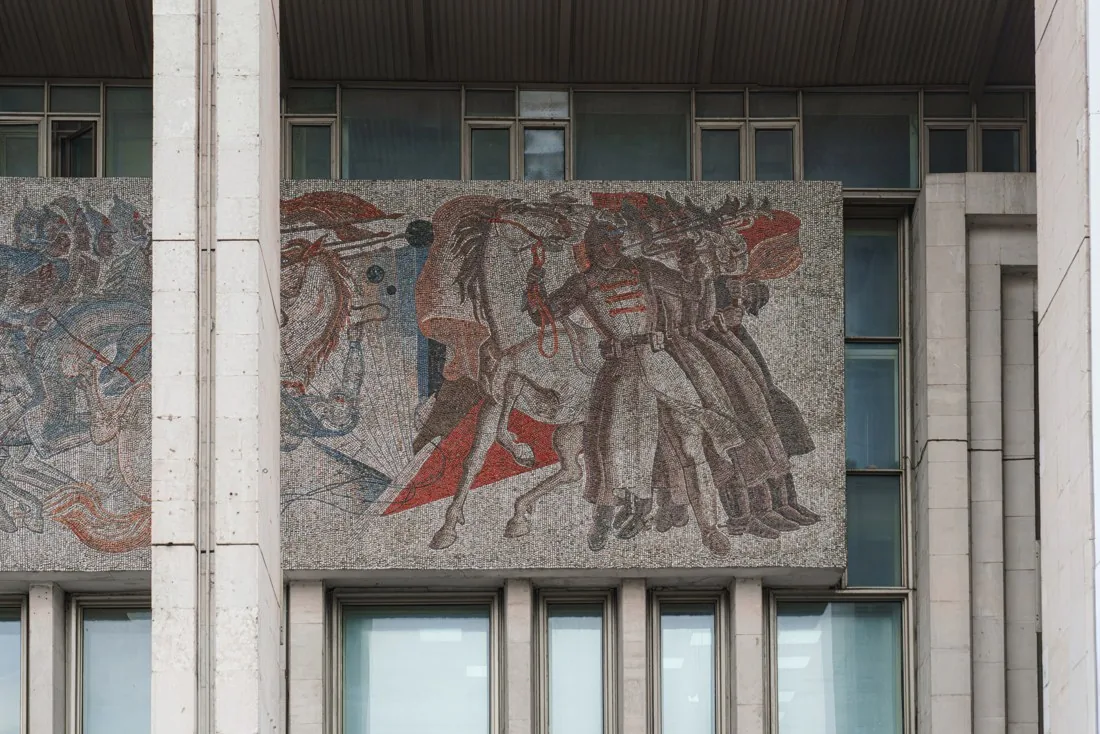
A long mosaic facade cannot always be understood from a single straight-on image. Columns interrupt the sightline, windows establish a lower rhythm, and the viewer’s position changes which figures are visible. Moscow Youth Palace offers a clear photographic example of this relationship.
The Alliance’s catalogue entry preserves the supplied attribution to Y. Korolev and the date 1987. Those are existing catalogue claims. This essay does not expand the initials, assign workshop roles or infer an undocumented commission history.
Locate the image on the building
In the featured photograph by Aigul Bedretdinova, the mosaic occupies a band above a row of windows. A pale column stands near the edge of the view. The image is therefore encountered through a structural frame, not as an unobstructed rectangular reproduction.
The first useful observation is positional: the figures sit above glazing and below the overhanging upper structure. That relationship can be seen directly. Whether a particular architectural element was designed specifically for the mosaic requires documentary evidence.
Follow gestures without naming a story too quickly
The visible figures establish movement through angled limbs and contrasting colour areas. Their arrangement can be described in terms of direction, grouping and overlap. It is less secure to identify a profession, historical personality or narrative episode solely from a gesture.
Try tracing the direction of one arm or body, then compare it with a neighbouring figure. Does the movement continue, reverse or pause? These are questions about composition that do not require an invented title for the scene.
The facade is a sequence
The catalogue’s other views show additional sections. Keep each section connected to its position on the building. A detail from one area should not be silently combined with another as though they formed a continuous photograph.
For a viewing notebook, use a small diagram with labelled photograph numbers. It need not be a measured architectural plan. Its purpose is to make the relationship among images explicit and to mark any uncertain sequence.
Archive dates and artwork dates
The source photographs carry embedded December 2025 dates. Those file dates are distinct from the catalogue’s artwork date and from this article’s eventual publication date. They do not prove that every visible feature remains unchanged.
Likewise, the image can show a surface integrated into a facade without establishing that the mosaic itself is load-bearing. That distinction prevents a common descriptive error: treating architectural placement as a structural-engineering claim.
Return to the whole
After studying a group of figures, look again at the windows and column. The surrounding elements affect the scale and rhythm of the image. That is the particular value of this photo essay: the building stays present while the mosaic receives close attention.
For further views and the preserved catalogue facts, explore the existing location entry. Additional primary records about the work can be shared with the Alliance through its contact page, with the relevant panel or facade section identified.
Explore further
Help us document the next mosaic.
Every gift funds photography, research and preservation advocacy.
Donate