Essay · November 19, 2026 · 3 min read
Photographing Ceiling Mosaics: What an Oblique View Reveals
By Slavic Art Alliance ·
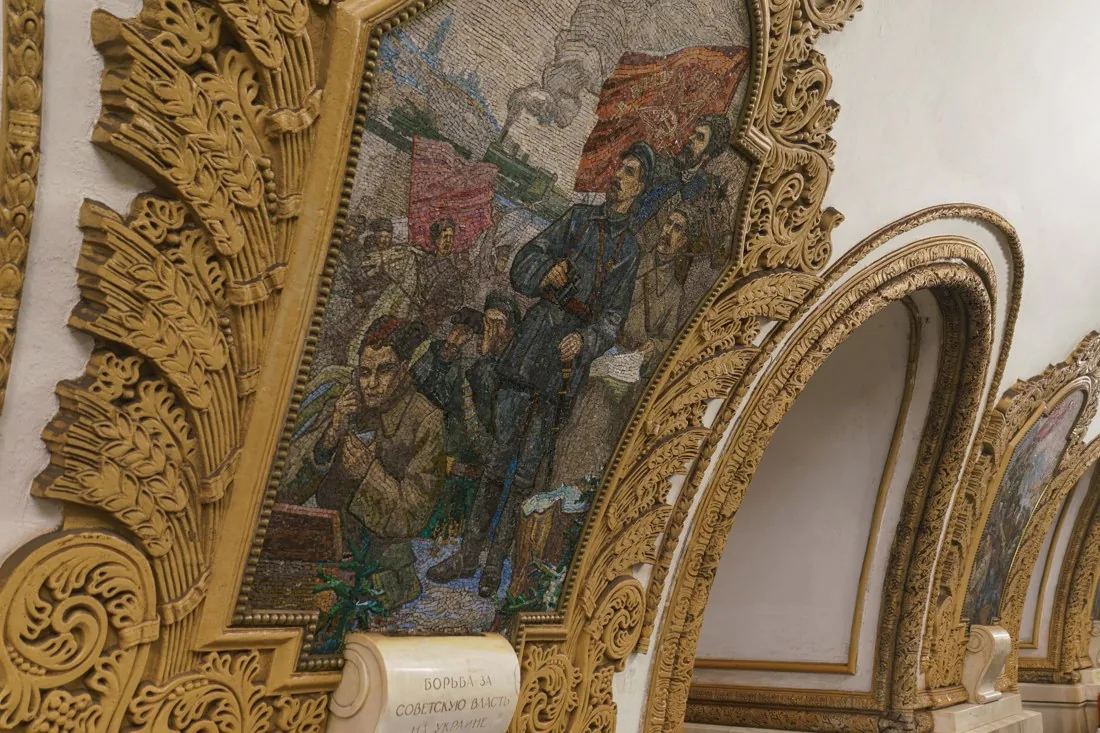
Ceiling mosaics ask the photographer to solve two problems at once: record an image overhead and explain where it sits in the building. A perfectly rectangular reproduction may be impossible from a permitted position. An honest oblique view can still be valuable.
The featured Komsomolskaya photograph by Aigul Bedretdinova shows a framed composition at an angle, with neighbouring arches visible. It is useful precisely because the perspective remains apparent. The image documents a viewpoint rather than presenting itself as a measured elevation.
Begin with a stable, permitted position
Choose a place where stopping does not obstruct movement. Check the venue’s current photography rules before using additional equipment. Do not assume that permission to take a handheld photograph also permits a tripod, flash or prolonged setup.
Take a context view that includes the panel and surrounding architecture. Then make a closer view if the available light, distance and rules allow it. The two images answer different questions: where the mosaic is, and what can be seen within it.
Check the result before moving on
Enlarge the image on the camera or phone. Look for motion blur, clipped bright areas and a focus point that has landed on a nearby frame rather than the mosaic. A photograph that looks convincing at thumbnail size may not preserve the detail you need.
If the light is difficult, make a second exposure rather than relying on aggressive editing later. Preserve the original files. An adjusted copy can improve readability, but it should remain linked to the untouched source.
Let perspective be visible
A rectangle photographed from below becomes a different shape in the image. Correcting that distortion may help presentation, but it does not produce verified dimensions. Strong correction can also stretch details and create a false impression of a direct view.
Keep an uncorrected image in the record. If a corrected derivative is used, label the adjustment. Do not stitch separate panels into a seemingly continuous ceiling unless the result is clearly identified as a composite.
Use the surrounding architecture
In the featured view, the ornate frame and arches help explain the ceiling’s depth and placement. They are not wasted space. Cropping them out may improve a detail illustration while making it less useful as a location record.
A practical sequence is: whole setting, complete panel, selected detail. The Getty’s MOSAIKON resources include specialist photographic-documentation training; they provide a useful further reference, not a claim that an informal visitor sequence equals a professional survey.
Write a caption that matches the image
State the location, viewpoint, photographer and available capture date. Mark a date as uncertain when it is uncertain. Avoid “as it looks today” unless the photograph and claim are genuinely current.
For Komsomolskaya, the Alliance’s catalogue supplies additional context. For your own photographs, retain the original files and record what each view was intended to show. A clear, limited record is more useful than a dramatic image that hides its own perspective.
Explore further
Help us document the next mosaic.
Every gift funds photography, research and preservation advocacy.
Donate